History of Zhytomyr
Origin of the name “Zhytomyr”
According to a local legend, recorded by the historian of the 19th century, priest Nikolai Tripolsky, Zhytomyr was founded around 884, and received its name after Zhytomyr, one of the comrades of the Kyiv princes Askold and Dir. He allegedly refused to serve Prince Oleg the Seer, who began to rule Kyiv after killing Askold and Dir in 882, hid in the forests and settled on a high cliff at the confluence of the Kamyanka and Teteriv Rivers (today’s historical center of Zhytomyr).
Pavel Jozef Safarik, one of the first scientific Slavists, proposed a version that the original settlement arose as the center of the Zhytiches tribe, which was part of the tribal union of the Drevlians. Its name literally meaning the “settlement of the Zhytichs”, like the tribe name itself, whose main occupation was farming, originated from the important agricultural crop of this region - rye (“zhyto”).
Zhytomyr in the 13th-17th centuries
In 1240, Zhytomyr was first mentioned in written sources (“The Tale of Bygone Years”), when during the Mongol invasion it was captured and destroyed. In 1287, it was again devastated by the Mongols.
In 1320 (according to other sources - in 1324), it was captured by Gediminas, the Grand Duke of Lithuania. In 1362, Zhytomyr was included in the Grand Duchy of Lithuania. In 1399, the Golden Horde Khan Edigu defeated the army of the Lithuanian prince Vytautas, captured and plundered Zhytomyr. In the late 14th century, it was mentioned in the chronicle “The list of Russian towns far and near” under the name “Zhytomel”.
In 1444, Casimir IV, the Grand Duke of Lithuania, granted Magdeburg rights (a set of town privileges regulating the degree of internal autonomy) to Zhytomyr and built a small castle in it. The castle was not preserved, but this place became known as Castle Hill. In 1474, Ambrogio Contarini, a Venetian ambassador, visited Zhytomyr during his trip to Persia and wrote about it: “a fortified town with wooden buildings.”
More Historical Facts…
In the 1540s, the Zhytomyr castle was rebuilt and fortified according to the design of the local architect Semyon Babinsky. Its thick walls were surrounded by a defensive moat filled with water. The population of the town was about 600 people.
In 1569, after the Union of Lublin between the Kingdom of Poland and the Grand Duchy of Lithuania, which laid the foundation for a federal state known as the Commonwealth, Zhytomyr became part of the Kingdom of Poland. In 1596, King of Poland and Grand Duke of Lithuania Sigismund III Vasa approved the right of Zhytomyr to hold two annual fairs, which contributed to the development of the town.
In 1648, during the Khmelnytsky Uprising (1648-1657), also known as the Cossack-Polish War, the troops of Bohdan Khmelnytsky stormed the Zhytomyr castle. The turning point in the history of the town was the year of 1667, when, under the terms of the Truce of Andrusovo between the Tsardom of Russia and the Polish-Lithuanian Commonwealth, Kyiv remained under Russian control, and the Kyiv courts were transferred to Zhytomyr, which in fact also became the administrative center of the Kyiv Voivodeship of the Kingdom of Poland. This event gave impetus to the intensive development of Zhytomyr.
Zhytomyr in the 18th - 19th centuries
In 1724, the Jesuits opened a monastery and a school in the town. In 1765, there were 5 churches (2 Orthodox and 3 Catholic), one palace and 285 houses in Zhytomyr. In the second half of the 18th century, a large Jewish community formed here.
In 1793, as a result of the second partition of Poland, Zhytomyr became part of the Russian Empire as a county town of the Volyn Governorate. In 1798, about 5,400 people lived in Zhytomyr. In 1804, it received the status of the administrative center of the governorate. Zhytomyr was a relatively large center of trade (timber, livestock, hops, and other goods).
The abolition of serfdom in 1861 and the development of capitalist relations contributed to the transformation of Zhytomyr into an industrial and commercial center. In 1885, there were 5,207 houses in Zhytomyr (of which 1,152 were stone), including 4,127 residential (660 stone). In 1897, according to the first census of the population of the Russian Empire, 65,895 people lived in this city (30,572 Jews, 16,944 Russians, 9,152 Ukrainians, 7,464 Poles, 677 Germans). In 1899, a tram service was opened in Zhytomyr.
Zhytomyr in the 20th century
In 1913, the population of Zhytomyr was about 90,700 people. During the Civil War in the territory of the former Russian Empire, power in Zhytomyr changed more than ten times.
In 1925, Zhytomyr became the administrative center of the Zhytomyr district of Kyiv Oblast. In September 1937, it received the status of the capital of a separate Zhytomyr Oblast. In 1939, the population of the city was about 95 thousand people, its industry was still underdeveloped.
On July 9, 1941, during World War II, German troops captured Zhytomyr. On December 31, 1943, the Red Army finally managed to regain control of the city. During the war, about 40% of the housing stock was destroyed, almost all enterprises, engineering communications, a railway station, a tram depot, a power plant, etc. were damaged.
The city’s population reached its pre-war level only in the late 1950s. Since that time, the rapid development of Zhytomyr began. Dozens of industrial, transport, construction, and engineering facilities were built including a flax processing plant, a chemical fiber plant, a metal structures plant, a meat processing plant, a laboratory glass plant, etc. From 1968 to 1976, the number of people employed in industrial production doubled. New higher, secondary special, research, design organizations were opened in Zhytomyr.
From 1959 to 1989, the population of Zhytomyr increased from 105,600 to 292,100 people. Since August 24, 1991, Zhytomyr has been the regional center of Zhytomyr Oblast of independent Ukraine.
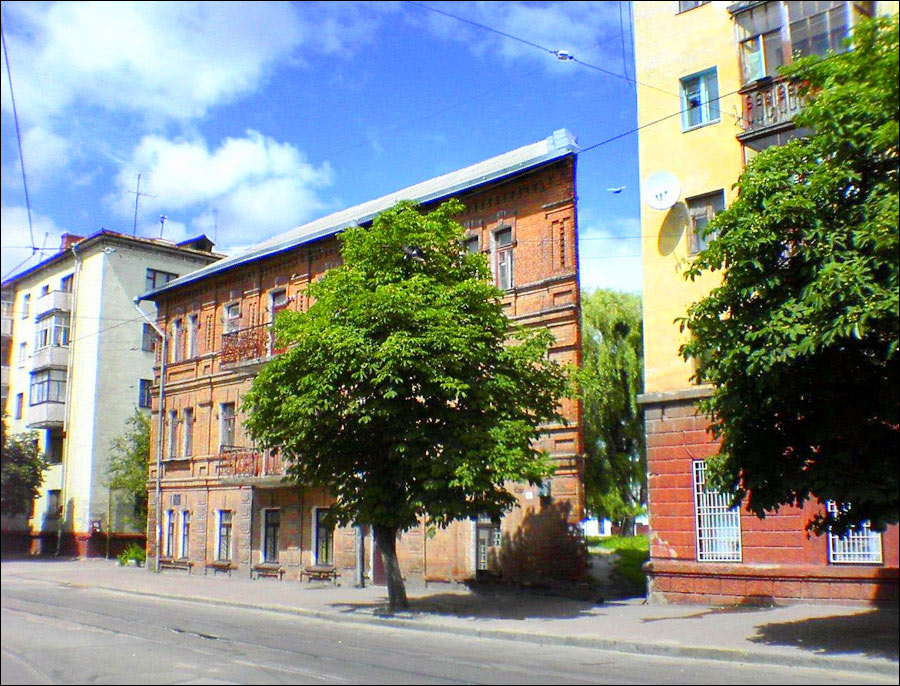
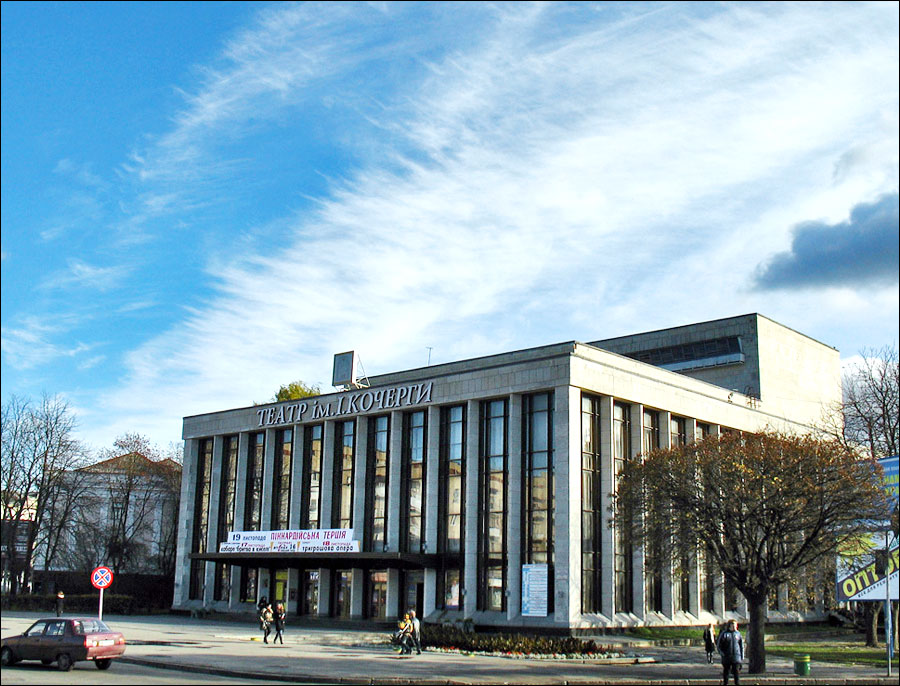
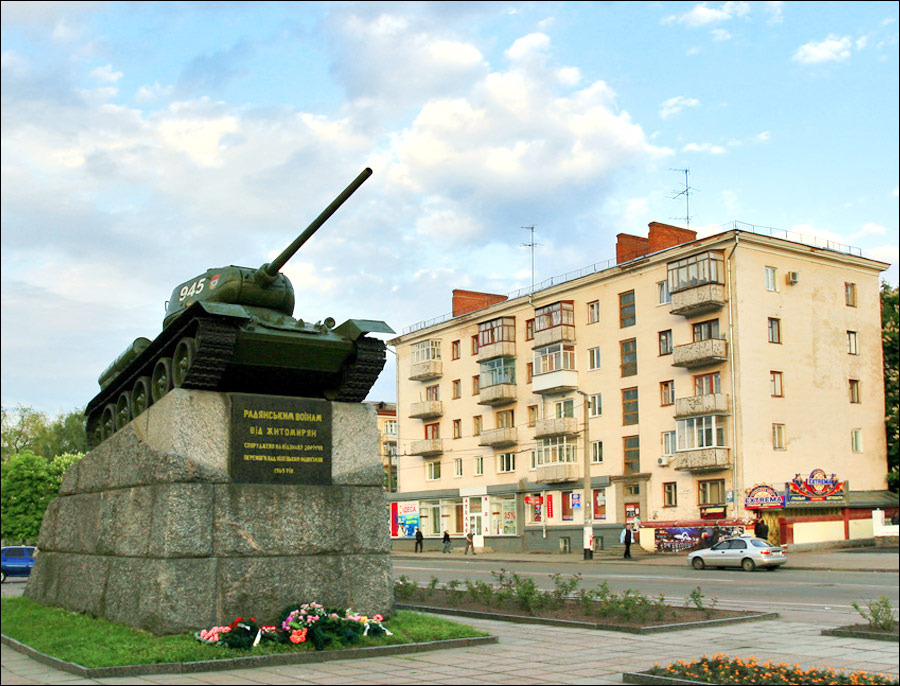
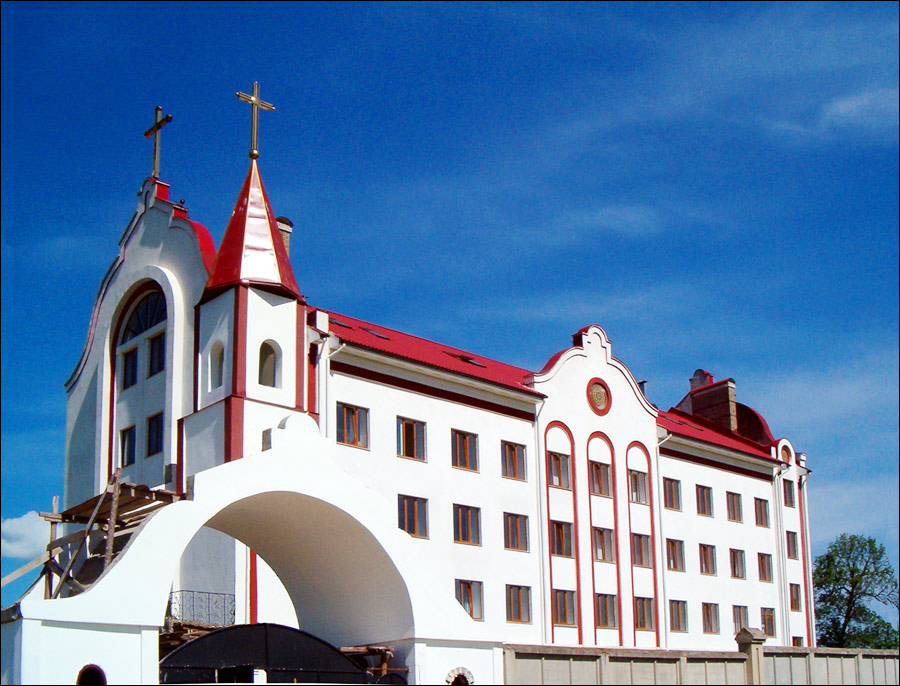
Architecture of Zhytomyr
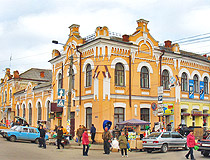
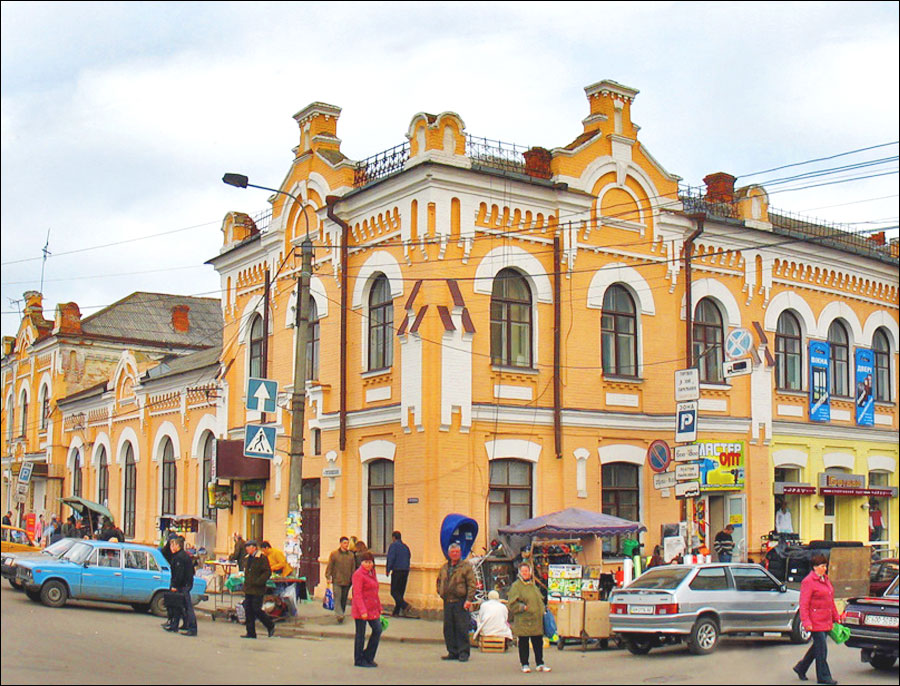
Street life in Zhytomyr
Author: Victor Galanin
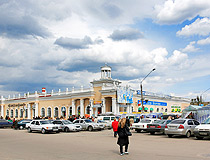
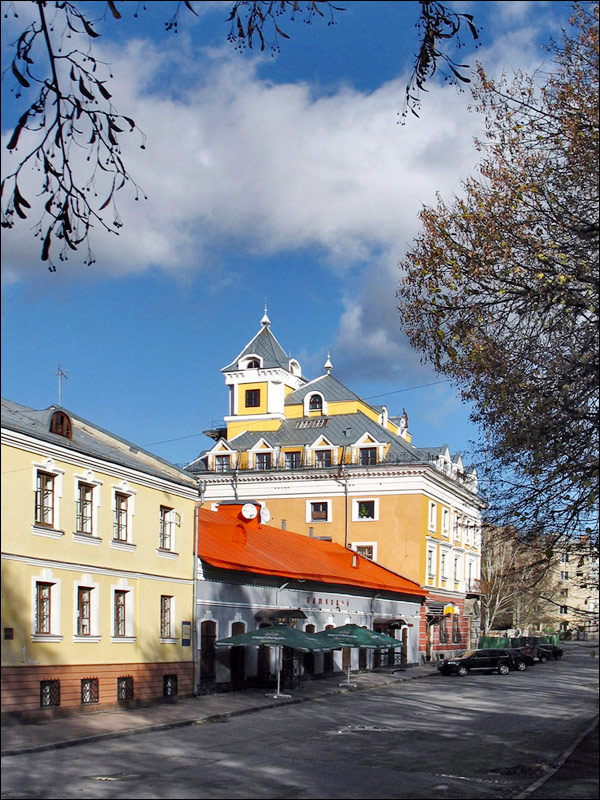
Cloudy day in Zhytomyr
Author: Victor Galanin
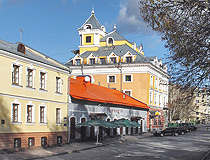
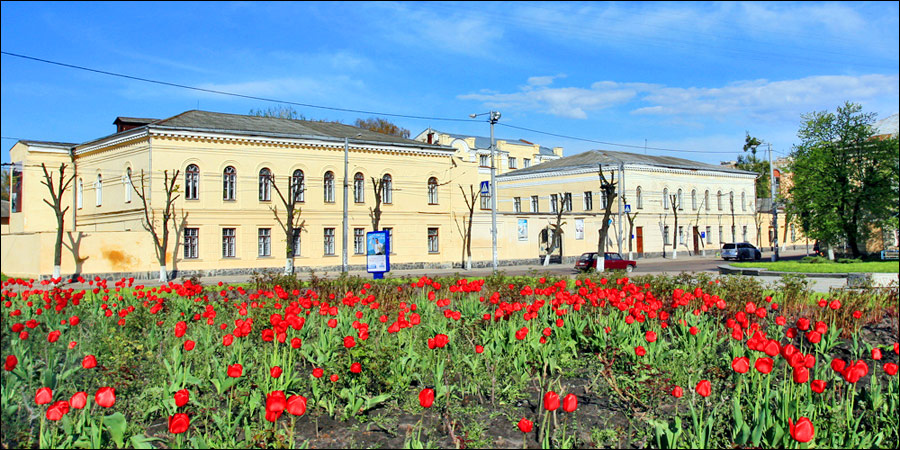
On the street in Zhytomyr
Author: Victor Galanin
Zhytomyr - Features
Zhytomyr is located about 140 km west of Kyiv. The City Day of Zhytomyr is celebrated on the second Saturday of September. About 22% of the population of Zhytomyr Oblast lives in Zhytomyr.
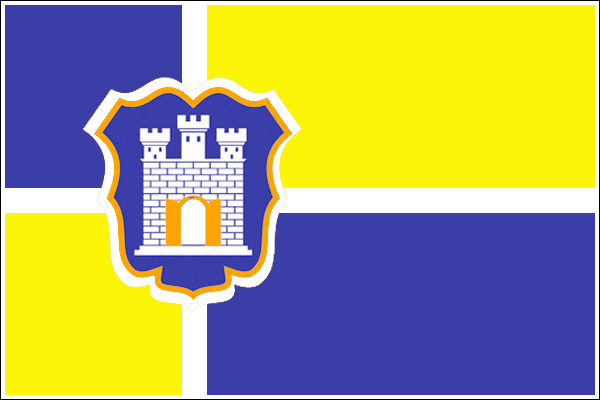
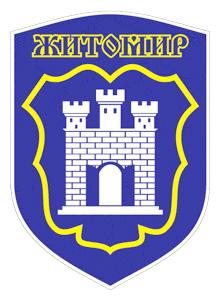
It is believed that the coat of arms of Zhytomyr has existed since 1390. The coat of arms of Zhytomyr, approved in 1796, had the following description: “In the lower part of the shield, in a blue field, there are open gates topped by three towers. This coat of arms was given to it by the princes of Lithuania in old times” (Zhytomyr was included in the Grand Duchy of Lithuania in 1362). The current coat of arms of Zhytomyr, approved in 1991, generally repeats its historical coat of arms.
The city is located in a zone characterized by a humid continental climate with warm summers and mild winters. The warmest month is July with an average temperature of plus 20.6 degrees Celsius. The coldest month is January, with an average temperature of minus 3.7 degrees Celsius.
It is an important economic and scientific center of Ukraine. The enterprises of Zhytomyr produce glass, metal structures, electronic devices, LED screens, confectionery, fabrics, furniture, shoes, car parts, etc. The processing of natural stone (gabbro, labradorite, various types of granite) is also developed.
Zhytomyr is a large transport hub of Ukraine. By rail, it is connected to such cities as Kyiv, St. Petersburg (Russia), Chisinau (Moldova), Vinnytsia, Odesa, Minsk (Belarus), Vitebsk (Belarus), Mogilev (Belarus), Lviv. Public transport in Zhytomyr is represented by one tram line, trolleybuses, buses, and mini-buses.
The historical center of Zhytomyr is geographically located in its southern part. The central square is Soborna (Cathedral) Square. The most famous and the central street of the city is the pedestrian Mykhailivska Street. There are several bridges in Zhytomyr. The most picturesque one is the metal Pidvisnyy (Suspension) Bridge across the Teteriv River in the Park of Culture and Rest.
Main Attractions of Zhytomyr
Sergei Pavlovich Korolyov Museum of Cosmonautics. In 1907, Sergei Korolyov, one of the main creators of Soviet rocket and space technology and a key figure in human space exploration, was born in Zhytomyr. In the house where he spent his childhood, furniture, personal belongings and documents of the Korolyov family are exhibited. The interiors were restored according to the memoirs of his mother.
The exposition of the pavilion “Cosmos”, opened in 1991, presents a unique collection of examples of space technology, equipment, as well as documents, photographs, souvenirs. The museum has models of Lunokhod-2, the Soyuz spacecraft, the life-size descent vehicle of the Venera-15 automatic interplanetary station, the descent vehicle of the Soyuz-27 spacecraft that has been in space, and other exhibits. One of the most valuable exhibits is a capsule with lunar soil donated by NASA.
Two rockets are installed near the Cosmos exposition building: a geodetic version of the R-5 (8A62) rocket (the first Soviet nuclear charge carrier, the latest modernization of the A4 - German V-2 rocket) and the R-12 (8K63) rocket (the first developed in Dnipro) with engine on high-boiling components. Dmytrivska Street, 2.
Zhytomyr Local History Museum. This picturesque old mansion, built in the very center of Zhytomyr for the head of the Zhytomyr Catholic eparchy in the 19th century, is called the Bishop’s House. In total, this museum has more than 160 thousand exhibits, which give a comprehensive idea of the natural features, history and culture of the Zhytomyr region.
The main exhibition space is occupied by the art department of the museum, where you can see a unique collection of works of fine art of Italian, Dutch, French, Polish, and Russian masters of the 16th-20th centuries. This museum also has a collection of more than 12 thousand stuffed animals. Zamkova Square, 1.
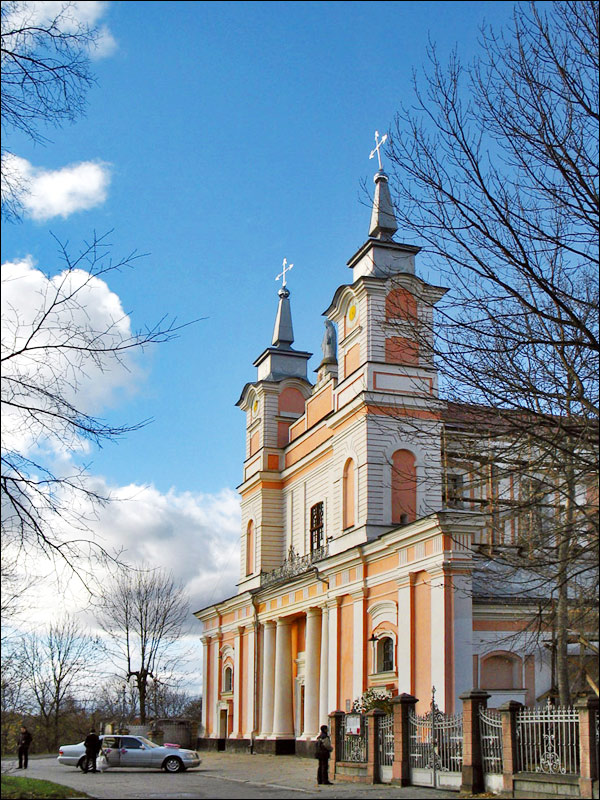
St. Sophia’s Cathedral (1737-1751) - one of the oldest architectural monuments in Zhytomyr. Originally, the cathedral was built in the Baroque style with Renaissance elements. In the 19th century, it was reconstructed and received a more classical appearance from the outside, but retained its baroque interior. Located near the Zhytomyr Local History Museum, it is known for its richly decorated interior with stucco molding and mural paintings. In 2011, a monument to Pope John Paul II was erected in front of the cathedral - on the tenth anniversary of his visit to Ukraine. Zamkova Square, 2.
Zamkova Gora (Castle Hill) - a rocky hill above the Kamyanka River and the historical center of Zhytomyr, where, according to legend, it was founded in 884.
On this territory, where the Zhytomyr castle once stood, today there is a small park, in the center of which you can see a picturesque monument to the founding of the city - a huge stone with the inscription “In 884, Zhitomir was founded here.” There is also an observation deck here, although the view from it opens on residential houses. Kafedralna Street, 3.
Park of Culture and Rest named after Yuri Gagarin - the most popular recreation area in Zhytomyr. This park, created in the 19th century, covers an area of 36 hectares, a large part of it is located on the slopes of the banks of the Teteriv River.
In front of the entrance to the park there are wonderful cascades of fountains, and on its territory there are shady alleys with exotic plants from Europe, India and North America. Right behind the main entrance to the park there are observation decks offering beautiful views.
One of the main sights of the park is a 350 m long suspension pedestrian bridge, laid across the Teteriv River. In addition, visitors to the park are especially attracted by a bronze sculpture of the goddess of hunting Artemis, as well as a number of sculptures depicting scenes from children’s folk tales, legends and epics. Staryi Boulevard, 34.
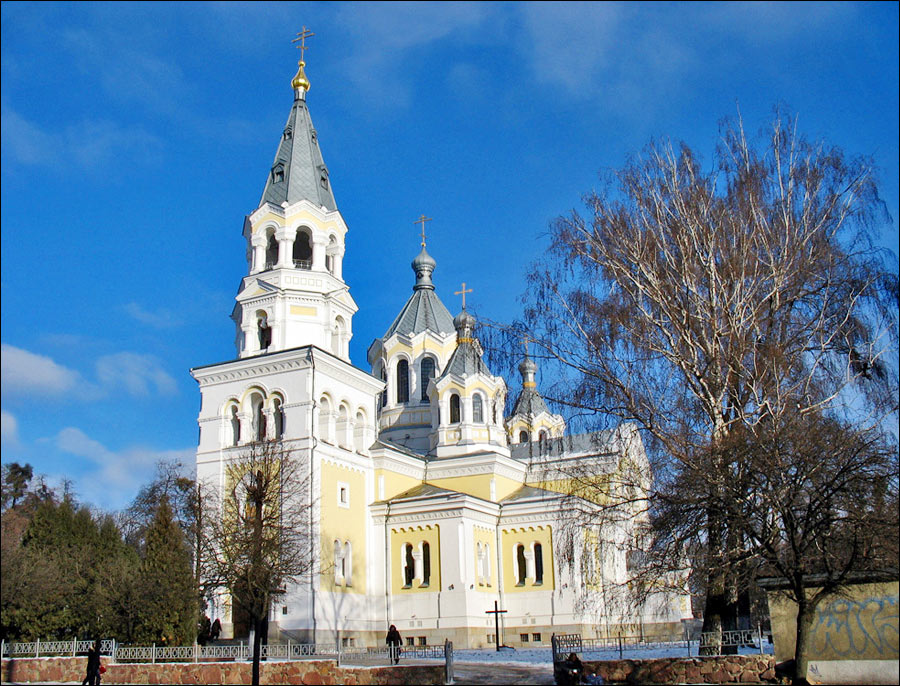
Holy Transfiguration Cathedral (1866-1874). This magnificent cathedral is one of the architectural symbols of Zhytomyr. The church was built in the Byzantine-Russian style with the characteristic features of the old Russian architecture of the 11th-12th centuries as the main Orthodox church in Volhynia. The height of its bell tower is 53 meters. The interior is richly decorated with granite and labradorite. It is one of the largest and most beautiful Orthodox cathedrals in Ukraine. Peremohy Square, 14.
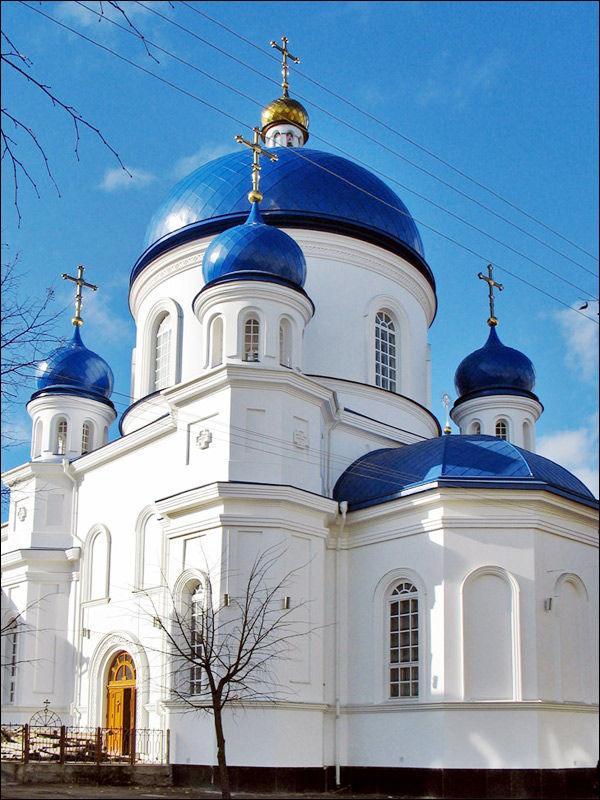
St. Michael’s Cathedral (1856) - an architectural monument of local importance built at the expense of the Zhytomyr merchant Mikhail Khabotin, one of the most beautiful buildings in Zhytomyr. Kyivska Street, 18.
Filippov’s Mansion (1886-1903). In the past, this very picturesque two-storey baroque building belonged to the Zhytomyr notary and lawyer I. Filippov. Today, “The House of Ukrainian Culture” is open in it. This is one of the most beautiful buildings in Zhytomyr, an architectural monument of local significance. Velyka Berdychivska Street, 61.
“Flat House” - a unique building in Zhytomyr, which is also called “The Chimera House” or “The Heart-shaped House”. It was built in the middle of the 19th century in the historical part of the city. Initially, it was a corner building standing at a sharp corner of the road intersection. To maximize the use of this territory, the architect decided to draw up a project of an unusual acute-angled building. If you look at it from a certain angle, it will seem to you that it has only a front part and windows without other walls. There are “flat houses” in Odesa and Lviv too. Peremohy Square, 8.
Zhytomyr Water Tower (1898) - an unusually beautiful red brick building constructed in the style of modernized Gothic - one of the symbols of the old Zhytomyr, an architectural monument of local significance. The height of the tower is 31 meters. During construction, the water tower deviated slightly from its axis, so the locals often called it “Pisa Tower”. Pushkinska Street, 24.
Zhytomyr Fire Tower (1894) - an architectural monument of local importance. Inside the building you can find the Fire Service Museum. The entrance is free. Sviatoslav Ri?hter Street, 33?.










The comments of our visitors